Kids up to 18yoUpon presentation of their ID card or passport for verification of their age and country of origin.
00€
Archaeological Museum of Kolona Aigina
Adults 18+Per person
10€
Free Admission
Kids up to 18yoUpon presentation of their ID card or passport for verification of their age and country of origin.
00€
Kolona
Adults 18+Per persson
10€
Free Admission
Kids up to 18yoUpon presentation of their ID card or passport for verification of their age and country of origin.
00€
Itinerary Description
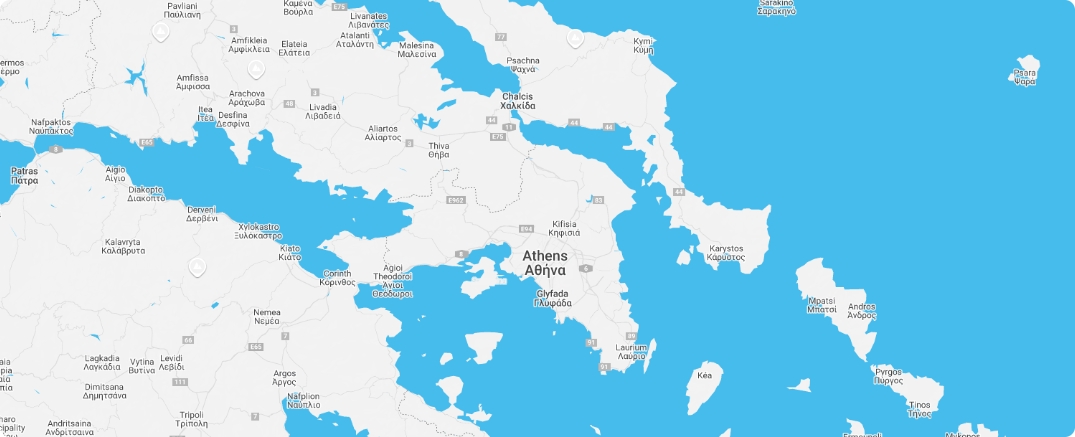
You will take the morning ferry from Piraeus port to Aegina and the trip will take about 1h20m. Aegina was the capital of Greece from 1827 to 1829. Aegina Town is situated on the west side of the island where the main port of the island is located. Agios Nikolaos, the tiny church, welcomes the visitor on approaching Aegina by sea. Numerous neoclassical buildings dominate Aegina Town, reminding the visitor of the glory of the island.
The Archaeological Site of Kolona: was inhabited in prehistoric times through the classical period. Extensive walls and foundations have been discovered and excavations are still in progress. One erect column is all that remains of a Temple of Apollo built in the 6th c. BC.
The Museum which contains a small but rich collection of pottery and sculpture from all periods of Aegina’s history. One of the most significant exhibits is the statue of the Sphinx (460 BC), which was dedicated to the Temple of Apollo. It is an extraordinary sculpture, with a head of a woman and a body that is half eagle and half lion, (Tues-Sun 08:30-15:00, Ticket: Full 3 Euros – Reduced 2 Euros)].
The Church of Agios Nektarios which is named after its patron, Agios Nektarios, who died in 1920 and was canonised in 1961. His memory is celebrated by the Church on 9 November.
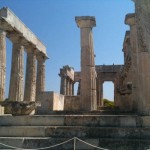
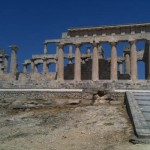
The Temple of Aphaia stands on top of a pine-clad hill above Agia Marina. The first temple on the site (700 BC) was dedicated to Aphaia, a deity from Crete. The Doric temple we see today was built about 490 BC of local porous sandstone, On a clear day, you can make out the Temple of Poseidon at Sounion, as well as the Acropolis of Athens. It is said that the three temples form an isosceles triangle (the sacred triangle of antiquity). You will also have lunch in a nice taverna, swim in one of the best beaches and take the afternoon ferry back to Piraeus.